Road trips are a classic Aussie adventure, and with long hours behind the wheel, food stops are an essential part of the journey. The right spots can turn even the dullest stretches into a journey brimming with fun, fuel and flavour.
But which popular road trip routes offer the best options for foodies, and which ones leave our cravings high and dry?
The team at ROLLiN’ were keen to find out. So, we conducted a study on Australia’s most popular road trips to see which delivers the best food along the way. Each route was analysed and ranked based on the number, quality, and rating of its culinary offerings.
From bakery runs to fine-dining detours, we're serving up a foodie’s ultimate guide to Australia’s most mouth-watering road trips.
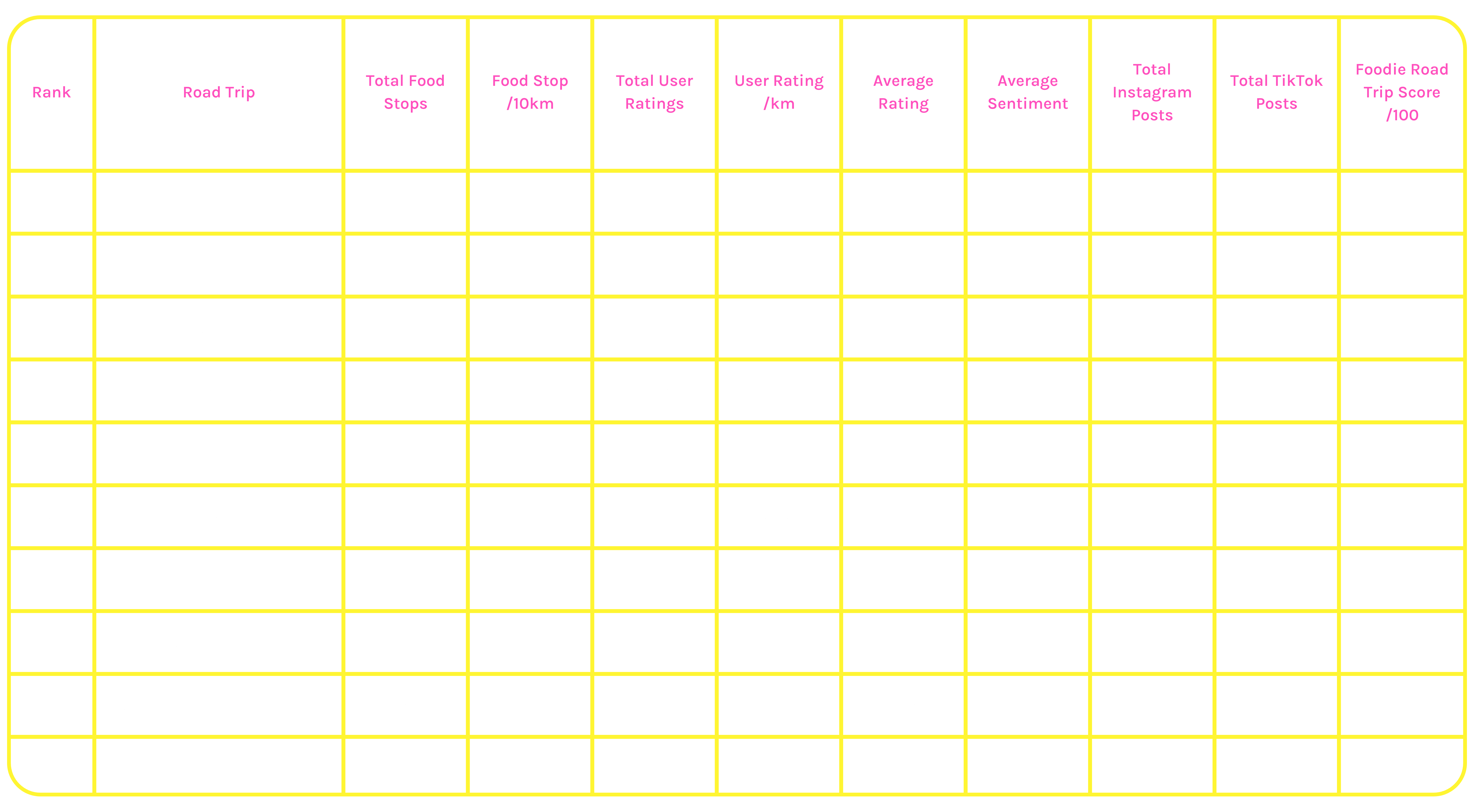
Top 10 road trips for foodies
Taking the crown for being the top road trip for foodies is the Legendary Pacific Coast, with a total score of 76.9. This 1,000-kilometre (km) drive stretches from Sydney to Brisbane, exploring the world-class wineries in the Hunter Valley, the dunes of Port Stephens and the iconic beaches in Byron Bay. Astoundingly, this route has 658 food stops with an average Google rating of 4.2. It also boasts over 116,000 posts for the top food spots on Instagram, highlighting its photogenic dishes that attract both locals and travellers alike.
Rounding out the top three are South Australia’s Epicurean Way (74.5) and Queensland’s Great Barrier Reef Drive (67.4). While the Legendary Pacific Coast leads thanks to its vast number of food spots, these two routes boast higher average Google ratings (4.49 and 4.27), highlighting their strong appeal.
The road trips with the most trendy food spots
The Legendary Pacific Coast has the most buzz on Instagram (116,420 posts across the top five food spots), highlighting its popularity among travellers who are drawn to its photogenic and trendy food spots like Broadbeach Tavern and The Star Gold Coast. This route is well ahead of Epicurean Way (24,808 posts) and Cairns to Cape York (45,601 posts), which also rank highly.
On TikTok, The Legendary Pacific Coast also leads with approximately 2,637 videos across the best food spots on the trip, ahead of the Epicurean Way, which has 744. Social media platforms like TikTok have proven to be a powerful tool that boosts tourism and gives real-time recommendations for those planning a road trip.
In comparison, Nullarbor Plain generated the least social media buzz, with just 1,181 Instagram posts and 7 TikTok videos across the top five food stops on the route. Tasmania’s Western Wilds follows closely with 2,173 posts on Instagram and 5 on TikTok. Both regional road trips feature limited food destinations, which may be why they receive less online coverage and traction from travellers seeking a photogenic experience.
The road trips with the most food stops per km
The Grand Pacific Drive is a clear winner, as it offers an astounding 370 food stops. This is the most stops of any other road trip. For every 10 km, travellers will encounter around 26 food destinations. With an average Google rating of 4.26, it is clear that tourists are loving the seafood, fresh produce, and seasonal dining this journey offers.
The Great Barrier Reef Drive has the second largest number of food stops, offering visitors a total of 177 destinations or more than 10 options every 10 km, providing travellers with plenty of dining choices.
Finally, the Cape to Cape completes the top three, with 104 destinations spread across just over 110 kilometres, which averages to 9.3 for every 10 kilometres. Known for its oceanfront cafes and refined regional cuisine, it’s a favourite among food lovers.
It is worth noting that while the Legendary Pacific Coast boasts the highest number of food stops overall (658), the length of the route results in a lower density of stops.
Road trips with the best-rated food stops
Tasmania’s Southern Edge has the highest consumer rating for its food stops, averaging 4.56 across its 49 culinary destinations - showing that foodies and travellers alike love the road trips’ paddock-to-plate cooking, hearty produce and charming local cafes like Summer Kitchen Bakery.
Cape to Cape in Western Australia and the Epicurean Way in South Australia trail behind with an average rating of 4.49. Both routes offer food lovers a rich experience filled with exceptional wine, gourmet food, and genuine regional charm.
The road trips with the least options for foodies
However, not every road trip is a favourite among foodies. The Nullarbor Plain, which spans from Western Australia to South Australia, is the lowest-ranking road trip for food lovers with a score of 17.7. Despite being a 1,200km journey, the route only offers 15 food stops or 0.1 for every 10 kilometres - including just 1 restaurant and 6 cafes. With so few choices, the social media engagement is also minimal, with just over 1,000 Instagram posts and 7 TikTok videos for the most popular stops. Despite this, its food maintains a high average rating of 4.37.
In second place is the popular Outback route, Red Centre Way, scoring 19.9. Known for its red desert sands, dramatic gorges and regional waterholes, this remote journey only offers 48 food stops - or about 0.4 every 10km. Evidently, with the focus on natural landmarks and outstanding scenery, culinary options are limited, making it less appealing to food-focused travellers.
Taking out the third spot is Explorers Way, with a total score of 21.2. Like Red Centre Way, this route is heavily focused on its striking and vast natural landscapes, offering just 121 food stops across more than 3,000km.
Brendan Griffiths, Executive Manager at ROLLiN, comments:
“Before you hit the road, it’s important to plan ahead for your trip, including where you’ll take rest breaks. Food stops can be some of the best parts of the journey, so take the time to map out where you’ll eat along the way – or come prepared with supplies if you’re travelling a more regional route.”
About the data
ROLLiN' has conducted a comprehensive study to analyse and rank 22 of the nation's most popular routes to identify Australia’s best foodie road trips. To find this, we ranked based on a proprietary index score that evaluates both the quantity and quality of culinary stops (defined as "bakeries," "bars," "cafes," and "restaurants") along each journey.
The final score for each road trip is derived from a Google Maps Score (60% weighting) and a Social Media Buzz Score (40% weighting).
Google Maps Metrics (60% weight):
This component of the index leverages data from the Google Maps API to measure the quality, quantity, and popularity of food stops along each route. The score is calculated from six key metrics, each with a specific weighting.
- Total Food Stops (10%): This metric measured the pure count of food stops that fell within a 15 km radius of the road of the specified road trip.
- Food Stop / 10 km (20%): To normalise for varying trip lengths, this metric measures the density of food stops. It ensures that shorter, food-rich routes are evaluated fairly against longer journeys that naturally have more total stops.
- Total User Ratings (10%): This metric captures the aggregate number of user ratings submitted for all food stops on a trip. It serves as a strong proxy for the overall popularity and public engagement with the culinary scene along a route.
- User Ratings/km (20%): This metric standardises the total volume of user ratings by the length of the trip. It provides insight into the level of diner engagement and popularity per kilometre, highlighting routes with consistently popular venues.
- Average Rating (25%): This metric calculates the mean of the average star ratings from all food stops along the route. A higher score signifies consistently excellent experiences.
- Average Sentiment (15%): This metric assesses the qualitative feedback from food stops. A sentiment analysis was performed on the top five most relevant user comments for each food stop to determine the underlying positive, neutral, or negative tone. These sentiment scores were then averaged across all venues on a given route.
Social Media Buzz (40% weighting):
This component measures the cultural impact and online visibility of each road trip's culinary scene. The analysis focused on the top five food stops for each route, which were selected based on a weighted combination of their Google Maps average rating and sentiment scores.
The Social Media Buzz Score was calculated based on the volume of user-generated content for these top venues on two major platforms:
- Instagram (60% weighting): Measured by the number of posts associated with the geotags of the top five food stops.
- TikTok (40% weighting): Measured by the number of posts associated with the geotags of the top five food stops.
Insurance issued by Insurance Australia Limited ABN 11 000 016 722 trading as Rollin’ Insurance. To see if a product is right for you, always consider the Product Disclosure Statement. Product Disclosure Statement and Target Market Determination are available from rollininsurance.com.au.